Roof Ventilation: 7 Essential Benefits of Professional Installation
Roof ventilation is an important part of a properly designed roofing system. While shingles, flashing, underlayment, and other roofing materials provide visible and structural protection, ventilation helps manage the conditions inside the attic and beneath the roof assembly.
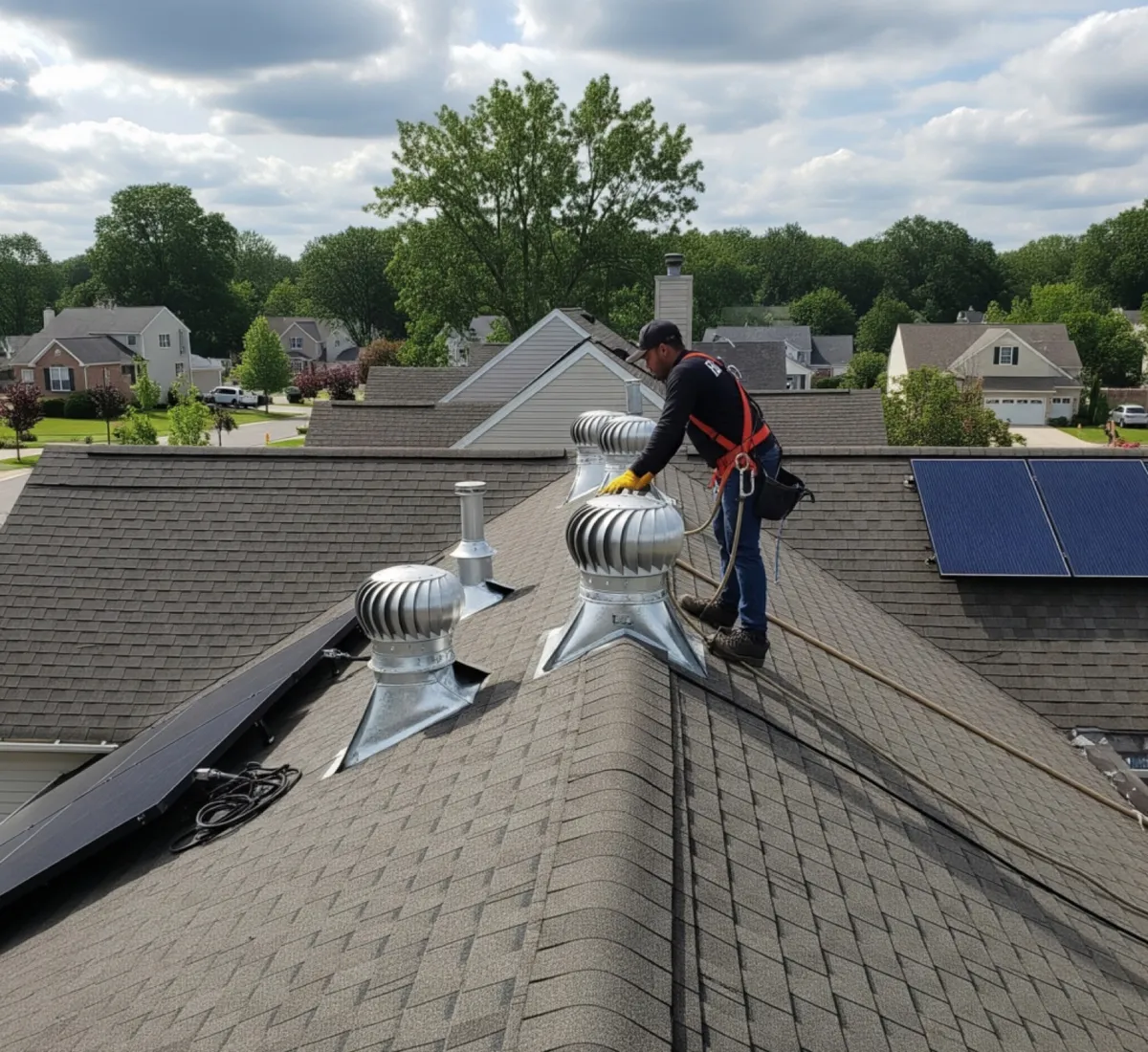
The photograph featured in this project provides a clear example of professional roofing work focused on ventilation. A roofing technician is shown working around large turbine-style roof vents installed along the roof ridge, while the property also includes solar panels. The image highlights how modern residential roofing can incorporate multiple systems while maintaining a clean and organized roof surface.
At All Pro Roofing & Chimney, the company provides a range of roofing services, including roof replacement, roof repair, roof installation, roof flashing repair, and solar attic vent installation. The company also provides chimney, gutter, siding, and masonry services.
This project demonstrates why ventilation should not be treated as a minor detail. Properly evaluated and professionally installed ventilation can be an important component of the overall roofing system.
1. What Is Roof Ventilation?
Roof ventilation refers to the controlled movement of air through an attic or roof assembly.
Depending on the design of a property, ventilation may involve intake openings, exhaust vents, ridge vents, soffit vents, gable vents, or other ventilation components.
The objective is not simply to put vents on a roof. A properly designed system needs to work with the structure, insulation, roof configuration, and applicable building requirements.
The National Roofing Contractors Association notes that attic ventilation can be an important consideration in roof-system design and installation. Its technical resources explain that ventilation can help remove excess moisture from attic spaces and reduce attic temperatures in certain conditions.
The photograph shows multiple large turbine-style vents positioned on the roof. These components are designed to facilitate air movement through the attic space when conditions allow.
Because every roof is different, ventilation requirements should be evaluated according to the specific building and roofing assembly.
2. Why Roof Ventilation Matters
A roof does more than keep rain out of a house.
The area beneath the roof can experience changes in temperature and moisture throughout the year. Without appropriate design and airflow, excess moisture can contribute to condensation and other problems in certain attic assemblies.
Professional roof ventilation can be part of an overall strategy for managing these conditions.
NRCA explains that, particularly in cold climates where snow may remain on roofs for extended periods, ventilation can help remove excess attic moisture, reduce condensation risk, and reduce the potential for ice-dam formation. NRCA also notes that ventilation can reduce average attic temperatures during summer.
However, ventilation should not be considered a universal solution for every roof.
The correct approach depends on the building design, climate, insulation, air sealing, roof assembly, and applicable requirements.
That is why professional inspection and planning are important before adding or changing ventilation components.
3. Professional Installation Requires Planning
One of the most important aspects of roof ventilation is proper placement.
The location and type of a roof vent should be determined according to the function it serves and the design of the roofing system.
The U.S. Department of Energy’s roof-vent installation guidance emphasizes determining the appropriate vent based on its purpose and carefully establishing the location before cutting into the roof deck.
This is especially important because installing a roof vent involves creating a penetration through the roofing system.
That penetration must be properly integrated with the surrounding shingles and flashing.
A professional installation therefore involves more than simply attaching a metal vent to the roof.
The roofing contractor must consider:
- Roof slope
- Existing ventilation
- Roof layout
- Attic configuration
- Shingle placement
- Flashing
- Roof penetrations
- Water-shedding details
- Intake and exhaust airflow
- Manufacturer requirements
- Applicable building requirements
The photograph shows a technician working directly around the ventilation equipment, demonstrating the importance of careful installation and attention to detail.
4. Turbine Roof Vents and Air Movement
The most prominent elements in this photograph are the large metal turbine vents.
Turbine vents are designed to move air through the attic when airflow and wind conditions cause the turbine to rotate.
Their effectiveness depends on the overall ventilation design rather than simply the number of turbines installed.
A roofing professional should therefore evaluate the entire ventilation system instead of assuming that adding additional vents automatically improves performance.
For example, a roof may require appropriate intake ventilation at the lower portions of the roof to work together with exhaust ventilation higher on the roof.
The U.S. Department of Energy has published residential building guidance describing balanced ventilation approaches involving lower intake and upper exhaust ventilation.
This is an important distinction for homeowners.
Roof ventilation is a system, not simply a collection of vents.
The technician’s work shown in the photograph illustrates why proper installation and system-level evaluation are important.
5. Roof Ventilation and Moisture Management
Moisture management is another important reason homeowners should pay attention to roof ventilation.
Warm, moist air from a home can migrate toward attic spaces. Under certain conditions, moisture can condense on cooler surfaces.
Over time, excessive moisture can affect materials within the attic and roof assembly.
NRCA’s resources specifically identify excess attic moisture and condensation as considerations in ventilation design.
However, ventilation is only one part of moisture control.
Air sealing, insulation, roof design, flashing, drainage, and other building components also play important roles.
The U.S. Department of Energy’s Building Science Education resources explain that air movement in ventilated attics can help remove excess moisture while proper insulation and air barriers remain important parts of the overall assembly.
For this reason, a professional roofing inspection should look beyond the visible roof surface.
A contractor should evaluate the condition and configuration of the complete roofing system before recommending changes.
6. Working Safely Around Roof Components
The photograph also highlights another important part of professional roofing work: safety.
The technician is working on a sloped roof while wearing a harness and other protective equipment.
Roof work requires specialized safety procedures because workers are operating at height and may be working around roof edges, penetrations, vents, solar equipment, electrical components, and other hazards.
Professional roof work requires careful movement across the roof surface as well as appropriate protection.
Safety is especially important when a project involves multiple systems.
In this photograph, the technician is working around ventilation equipment while solar panels are also installed nearby.
This type of environment requires careful planning so that the roofing system, ventilation equipment, solar installation, and worker safety are all considered.
7. Roof Ventilation and Solar Panels
Another notable feature in the photograph is the presence of solar panels.
Modern residential roofs may contain several different systems, including:
- Asphalt shingles
- Roof vents
- Turbine ventilators
- Solar panels
- Electrical components
- Plumbing penetrations
- Chimneys
- Skylights
Each component occupies part of the available roof surface.
When performing roof ventilation work around solar equipment, professionals need to consider the location of panels, access pathways, penetrations, and the existing roofing assembly.
The objective is to complete the ventilation work without unnecessarily disturbing other roof components.
The photograph demonstrates how several roofing-related systems can coexist on the same roof when properly planned and maintained.
For homeowners with solar panels, this is particularly important when scheduling roofing inspections, repairs, or future roof replacement.
8. Maintenance and Professional Inspection
Even a professionally installed roof requires periodic inspection.
Homeowners should pay attention to visible signs such as:
- Damaged or missing shingles
- Rust or deterioration around metal components
- Loose flashing
- Water stains inside the home
- Condensation or excessive moisture in attic areas
- Damaged roof vents
- Unusual roof movement
- Storm-related damage
- Deterioration around penetrations
A professional inspection can help identify problems that may not be visible from ground level.
All Pro provides roof inspections and free, no-obligation estimates according to its published service information. The company states that its inspections evaluate roof conditions and provide recommendations based on the property.
For homeowners who are unsure whether they need repair, replacement, or ventilation work, an inspection can help establish the actual condition of the roofing system before work begins.
9. All Pro Roofing & Chimney Services
All Pro Roofing & Chimney provides residential and commercial roofing services throughout New Jersey.
Its published roofing services include roof replacement, roof repair, roof installation, roof framing, roof construction, asphalt shingle roofing, cedar shake roofing, metal roofing, solar attic vent installation, roof waterproofing, roof flashing repair, flat roofing, TPO, PVC, roll roofing, and skylight services.
The company also provides chimney services, gutters, siding, and masonry services.
This range of services is particularly useful when multiple exterior components need to be evaluated during a roofing project.
For example, a roofing inspection may reveal an issue involving flashing, ventilation, gutters, or a chimney connection.
Addressing related components as part of a coordinated project can help maintain the integrity of the entire exterior system.
All Pro states that it is family owned and operated and offers free estimates, licensed and insured professionals, and emergency services.
For inquiries and estimates, the company publishes (201) 773-6635 as its contact number.
10. Final Thoughts
Roof ventilation is an important part of understanding how a roofing system performs as a whole.
The photograph shows a professional technician working with roof-mounted ventilation equipment on a residential property that also includes solar panels. It provides a useful example of the detailed work involved when multiple components are installed and maintained on the same roof.
Good roofing work is not limited to what can be seen from the street.
The shingles, flashing, ventilation, roof penetrations, attic conditions, drainage, and supporting components all contribute to the overall roofing system.
Professional evaluation is especially important when homeowners are considering changes to ventilation or when an existing roof has developed moisture, leak, or performance issues.
All Pro Roofing & Chimney offers roofing services including roof ventilation-related solar attic vent installation, roof repair, roof replacement, roof installation, and flashing repair, along with chimney and other exterior services.
For a professional inspection or estimate, homeowners can contact All Pro Roofing & Chimney at (201) 773-6635.